In Laos we chose to stay in Luang Prabang, an important historic city, the intermittent capital, and the modern religious center of Lao(s). When Laos was annexed by France in 1893 it was declared as the seat of the monarchy, and many of the buildings in town date from the French colonial period. It is situated where the Nam Khan river joins with the Mekong, surrounded by rugged jungle-covered mountains and, like everywhere else in southeast Asia that we go, it is filled with butterflies.
The town is now a tourist destination, imagine Key West but replace the idolatry of Jimmy Buffet with the Buddha. There are many many monasteries and temples, and the daily ritual of giving alms to the monks even attracts the tourists (Elizabeth woke up early on the last day to attend the ceremony). This is a little bit incongruous in a country that is, ostensibly, an irreligious Marxist state (the last king of Laos died in a communist re-education camp in 1975), but it seems like in Luang Prabang at least the Buddhists have made a functional alliance with the capitalist tourists.
 |
| Vendors are set up to sell food to tourists to give to the monks. Not exactly efficient. |
 |
| Monks who have taken a vow of poverty depend on daily offerings of rice |
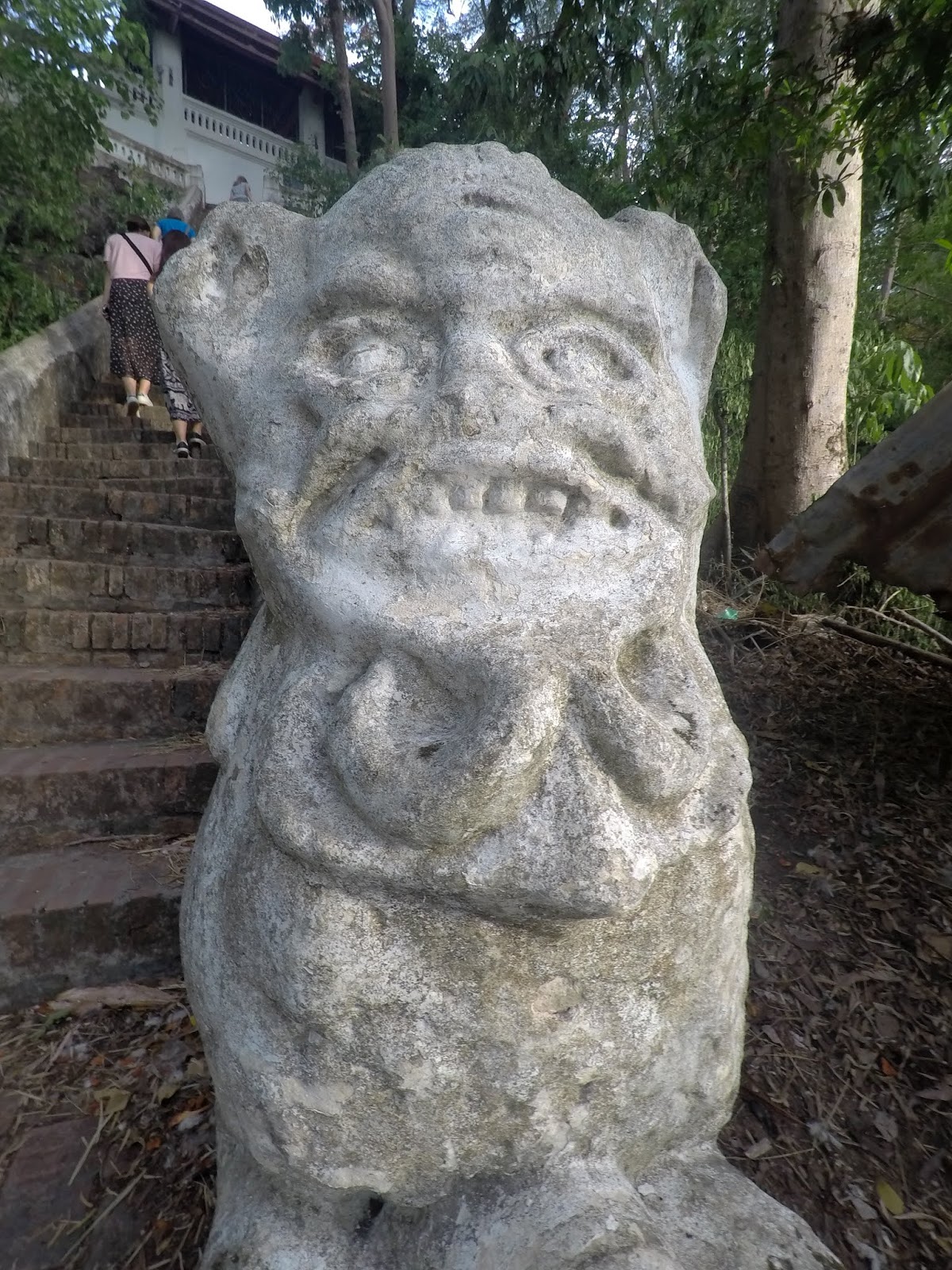
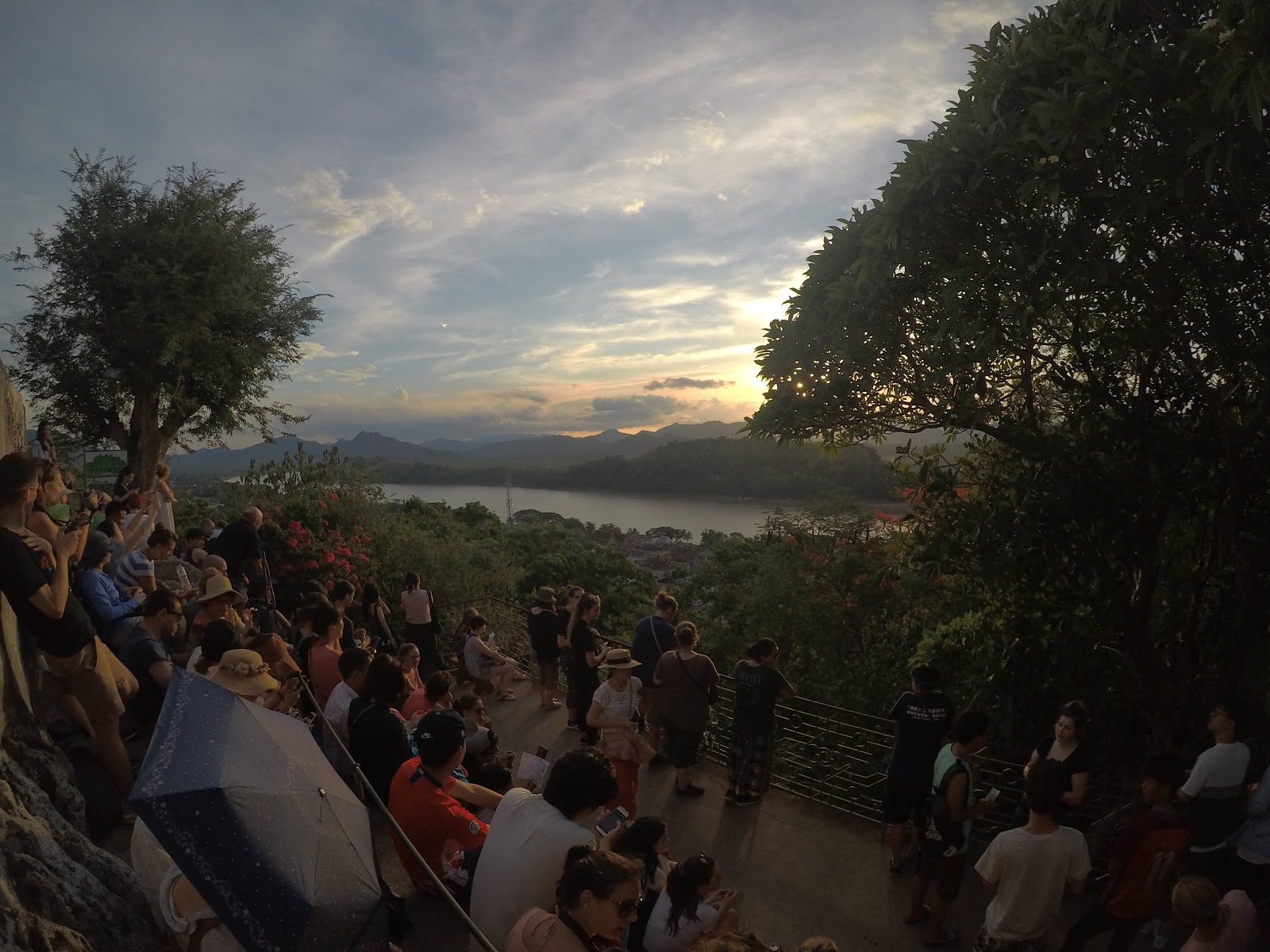
On our first full day we explored the town a little, and hiked to the top of Phu Si to watch the sunset. Phu Si is a sacred mountain situated in the very middle of the town (across the street from the old royal palace) covered in temples, shrines, and sacred caves.
 |
| Mopeds are the dominant life form in Southeast Asia |
 |
| Climbing stairs is apparently how you earn yourself a favorable reincarnation |
 |
| NYAR! |
 |
| Laos is very very pretty. |
It is also the best spot to watch the sunset over the mountains, and so is choked with tourists and Lao schoolchildren there to practice their English.
 |
| Remember: you're not stuck in traffic, you _are_ traffic. |
 |
| Her Pineapple Majesty holding court |
 |
| It was, after all that, a pretty gorgeous sunset. |
This was the first place on our big tour where we had to confront “ugly” tourism, self-entitled visitors ignoring all local customs and cultural norms. SE Asia is a relatively conservative place, with high neck-lines and polite signs requesting you to keep the public displays of affection to a minimum. On Phu Si was our first run-in with bikini-clad westerners drinking from their huge bottles of Lao beer in a sacred Buddhist temple. As we’ve traveled more and more and as we’ve made more and more of an effort to interact with the locals we’ve come to feel more like polite guests in the places we visit and less like consumers simply buying tours and trinkets. This has led to many more rewarding experiences, even though it sometimes means sacrificing comfort and convenience.
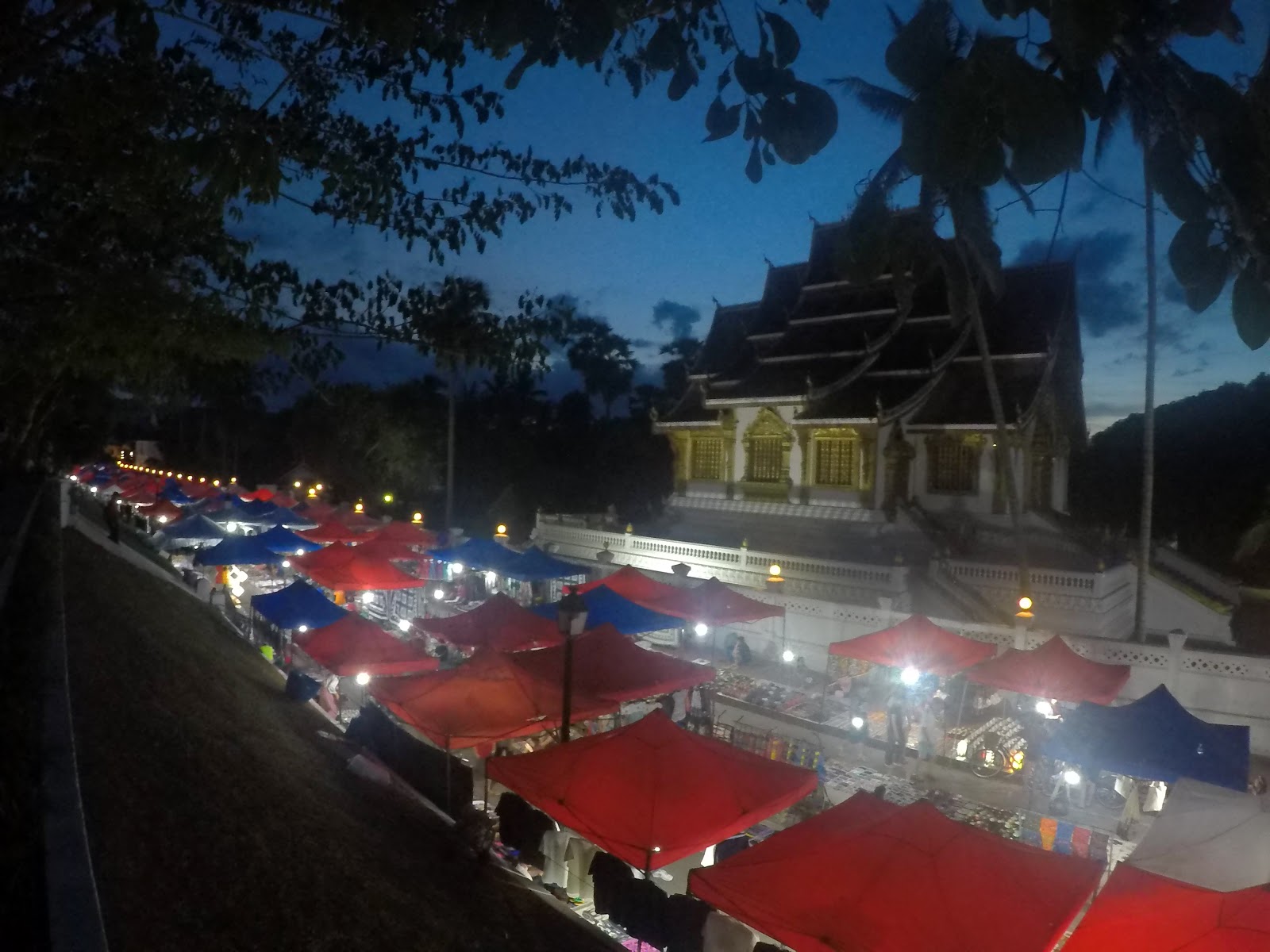
After sunset we hiked down the mountain and ate at a market barbecue. The night market food district runs down a narrow alley lined with grills and assortments of meats pincered between split stalks of lemongrass and piles of raw veggies and various other dried and prepared food sellers. We chose a few things from one display (pork belly and chicken wings) and ordered some rice and the cook’s speciality - a spicy papaya mango salad. We picked a few cold drinks out of a cooler and grabbed a table that it turned out was in the domain of the next guy down who was selling fried dumplings, so we were obliged to buy a dozen delicious dumplings as well. The meats all came with special and inscrutable sauces, and the salad was just on the right side of too spicy. After we ate we explored the rest of the food alley, and it eventually gave way to “all you can eat” noodle and vegetable buffets where you could fill a plate with starch and veggies and they’d stir fry it all up for you for $1 USD.
 |
| Night market - mainly for the tourists. Full of elephant print pants and bottle openers made from bomb casings. |
 |
| So hard to choose! |
 |
| Eating sticky rice with our hands, the way it was intended. |
The next day we took a boat to visit Pak Ou cave, a local sacred place where Buddha statues from homes and temples are placed after they have reached the end of their useful lives. It was a two hour boat ride up the Mekong, which at the end of the hot dry season was very low. If you were to follow our itinerary later in the year it’s actually possible to go from Chiang Rai to Luang Prabang by boat, but at this time of year even our little boat had to weave back and forth across the river to find enough depth. Once we got there we hiked up a short ways to the cave, which was filled with thousands of statues of all sizes, as well as statues of hermits and other other icons. We made donations and rang the bells like you do.
 |
| This one looks river-worthy! |
 |
| Mountains everywhere |
 |
| Pulling up to the bamboo dock. |
 |
| A nice view. Not pictured: the bats right above our heads |
 |
| Buddha buddha buddha |
 |
| Someone is in good spirits because she is being carried |
On the way back (only an hour when we were going
with the current) we had the driver drop us off on the far (and more fashionable) end of town, and ate a late lunch at a fine French restaurant (l’Elephant) run by a Laotian who went to culinary school in France and his business partner, who was a consultant for France Telecom before deciding he’d rather be a restauranteur in Laos. We had fine foods and lots and lots of french fries.
 |
| Danger Monkey's first experience with french onion soup |
That evening we attended a storytelling/music performance in the world’s tiniest theater, and heard the origin myth of the Phu Si (it was brought there by Haruman the monkey king from Sri Lanka so that the queen could harvest mushrooms from it), the origin of the “Khene”, the traditional instrument that they were playing which was basically a bamboo organ bagpipe contraption (it was made to sound like a specific magic bird) and the origin of the mountains across the river (which is too complex for a parenthetical).
 |
| We almost bought a Khene ourselves, but resisted the temptation |
The next day was arts and crafts day! Elizabeth spent the morning learning traditional weaving (and marveling at the mechanics involved in adding fancy patterns to a basic piece), and Michael and the eldest two children spent the afternoon learning how to make Hmong hunting bows.
The Hmong handicrafts are not kept alive entirely by altruism and tourism, but also by purely economic reasons. The Hmong diaspora of refugees and American collaborators fleeing the Secret War in Laos are now primarily living in the US (predominantly in California and Minnesota) where they get much higher wages and still want traditional new year outfits and other local goods, so a lot of the businesses we saw are making traditional hand-crafted artisanal goods for export.
 |
| Apparently most of the battle is setting up the loom in the first place |
For the bow-making class Michael and the kids took a tuktuk ride up to the edge of the jungle and were instructed on how to create traditional Hmong hunting tools (bows and crossbows) by a master bow maker and his sons. It turns out the first step to making a Hmong bow out of bamboo is “spend 15 years working with a machete literally every day to develop your knife skills”. Her Pineapple Majesty and Michael did alright at shaping their bows, but Middle Child’s crossbow was mostly made by the teacher. Every part of it was made by hand with a sharp heavy knife, a chisel, and sharpened pieces of rebar that were heated in the fire to burn holes through the teak handle and bamboo trigger. Bamboo really is an amazing material - it's like plastic pipes that grow straight up out of the ground! The string on the crossbow was made from a hemp rope which started as a big bunch of dried grass, and was then pulled against a post to separate the chaff from the fibers, rolled by hand into a rough rope, woven into itself to make the loops, run through the top of a fire to sear off the loose bits and tighten it up, rubbed with mystery green leaf to smooth it out even more, and then the striking/sliding surface had a strip of rattan cane woven through and around it to reduce friction and improve durability. The bows could all pierce a target pretty accurately from about 20 feet away, and we were told that for actual hunting they would coat the tips in a paralyzing poison.
 |
| Carving the teak handle with a giant knife |
 |
| Burning holes through the bamboo for the arrow to travel through |
 |
| ACTION POSE! |
Meanwhile, Elizabeth kept Danger Monkey away from fires and sharp knives, instead exploring the ethnology museum - which contained a musical instrument room for Elizabeth to geek out in, as well as an impressively interactive area for dress-up and trying out crafts and instruments. Danger Monkey liked the kazoo (not a traditional Laotian instrument).
 |
| Danger Monkey visited the ethnology museum while the bigs were off making weapons |
The following morning we hired a van to take us up to visit the Kuang Si waterfall. Our guest house was in a narrow motorcycle-only street, and where it met the main drag there were always a couple of tuktuk and van drivers waiting to see if anyone wanted to go to the "WaterfallCaveWhiskeyVillage?!" We negotiated a reasonable round trip fare and piled in. It was about an hour to the wilderness park that housed the waterfalls (as well as a bear rescue center where moon bears that had been kept for bile production were rehabilitated) and we were passed by many pickup trucks full of backpackers. The waterfall pools were cold (refreshing!) and full of nibbly fish and western tourists. There were also a few locals bathing in the pools and just cavorting and cooling off.
 |
| All problems are irrelevant when you are swimming in a waterfall |
After swimming in the pools we chose to take a hike up to the top of the waterfall. When there are warning signs in the US we tend to assume they’re there for legal liability reasons and largely ignore them. When there are warning signs in SE Asia they are totally serious. This was, in fact, a very steep and slippery trail. For one portion the wooden stairs were in the running water, and the mineral content was so high that they were encased in limestone. The top of the waterfall was like an Alice in Wonderland jungle, all thick vines and deeply shadowed by the thick canopy. There was a swing over the river with some children playing on it, but other than that the entire place was dark and still with lots of huge-leafed plants and the occasional bunch of bright flowers.
 |
| Playing fishing at the top of the waterfall |
After exploring at the top we hiked down another insanely steep and slippery slope. We took one more dip in a waterfall pool to cool off from the hike, and got lunch at a nearby barbecue joint. We ordered a few things that were on the cooking grate at the front of the restaurant that looked enticing, Elizabeth and Michael shared a huge grilled fish and the kids had half a chicken.
 |
| Yum. |
We stopped on the way back at a local dairy that rents buffalo from the local farmers to get their milk, and then makes fancy cheeses and ice cream. The ice cream was basically indistinguishable from regular ice cream, and the kids got to play with the rabbits, chickens, and piglets that were also at the farm.
 |
| Also yum. |
That night Her Pineapple Majesty and Michael went exploring way off the tourist track to try and find a solution for shipping a pair of bamboo hunting bows back to Minnesota. They eventually found a shop that was basically the general store for the tourist businesses, it sold office supplies (including the big form-factor calculators that are necessary for communicating and arguing about prices) and restaurant supplies, and a few snacks and paper offerings for burning at temples. They picked up a couple of plastic signboards and a roll of duct tape and were able to fashion a truly ridiculous package back in the hotel room. Here’s hoping the Lao Poste can get it to the US!
 |
| The Lao Poste employees were exceptionally helpful. Hopefully we'll see our souvenirs again in 1-2 months! |
 |
| Morning market. The open-top tubs are full of eels, the screen-covered tub is full of frogs. |
Next up: a 22-hour layover on our way to Bali means a quick interlude in Bangkok.